
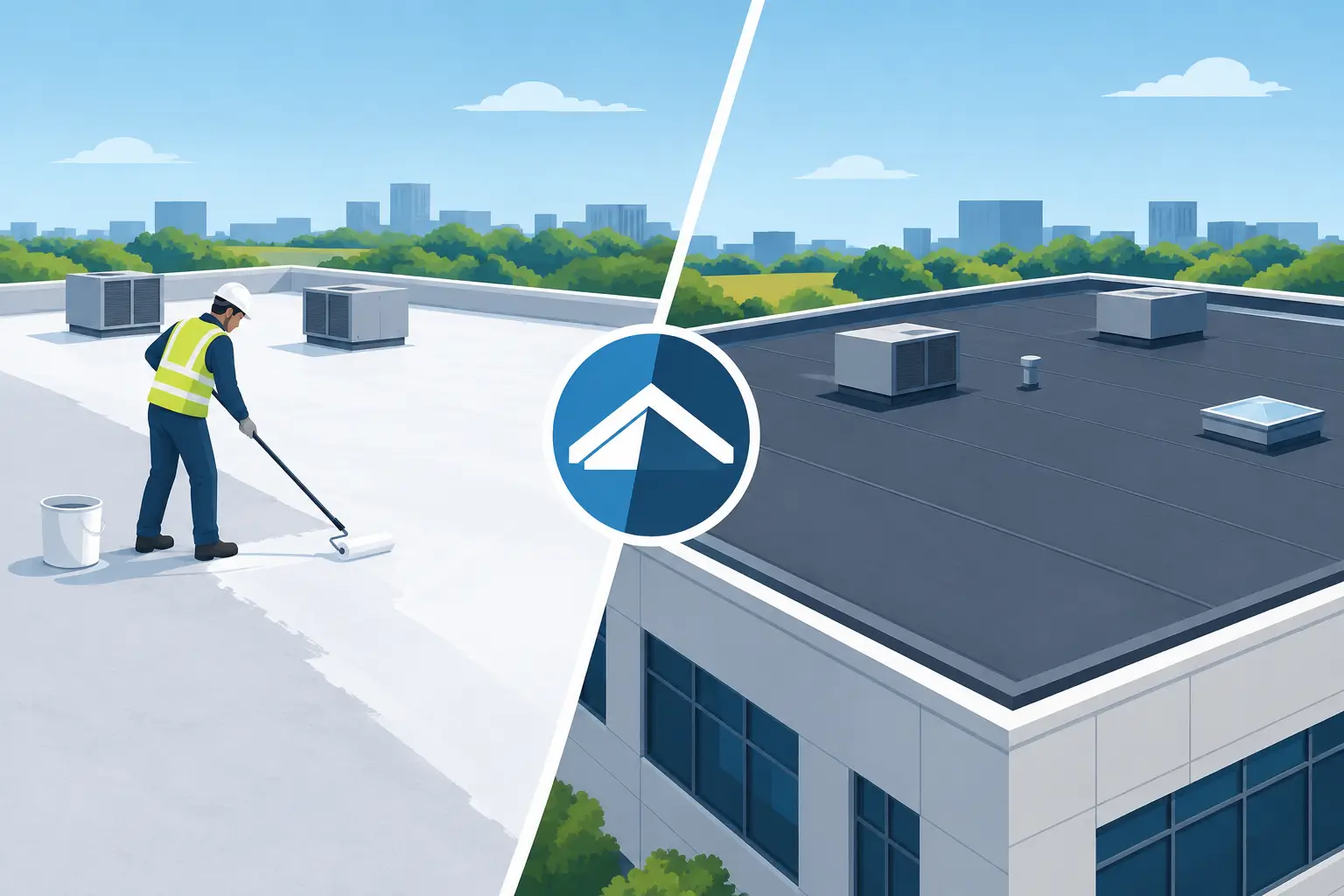
A commercial roof rarely fails on a convenient schedule. A small leak can interrupt operations, damage insulation, threaten inventory, and create expensive interior repairs long before the roof looks seriously worn. When owners weigh commercial roof restoration vs replacement, the right decision comes down to the roof’s condition, moisture levels, remaining service life, and the long-term needs of the building – not simply the lowest immediate price.
For commercial properties across Nevada and Northern California, that decision also has to account for intense UV exposure, wind, snow loads, temperature swings, and seasonal storms. A qualified inspection identifies whether a roof can be restored into a reliable, energy-efficient system or whether replacement is the safer investment.
Commercial Roof Restoration vs Replacement: The Core Difference
Commercial roof restoration renews an existing roof with repairs and a protective coating system. The process typically includes correcting leaks, securing seams and flashings, replacing damaged sections where appropriate, preparing the roof surface, and applying a compatible coating. The finished coating creates a continuous, weather-resistant surface that can reflect sunlight, reduce thermal stress, and extend the roof’s useful life.
A roof replacement removes the existing roofing system down to the deck or an approved substrate, then installs a new assembly. Depending on the building and roof design, that may include new insulation, vapor protection, drainage components, membrane roofing, metal panels, or another specified system. Replacement addresses widespread failure and gives the building a new roofing baseline.
Neither option is automatically better. Restoration is often the cost-effective choice for a roof that is fundamentally sound but weathered. Replacement is necessary when hidden moisture, structural concerns, or broad system failure make a coating a short-term fix rather than a dependable solution.
When restoration makes financial sense
Restoration works best when the existing roof still has a stable substrate and limited, repairable damage. A single-ply membrane, metal roof, modified bitumen roof, or built-up roof may be a strong candidate if it has surface aging, minor seam issues, isolated punctures, or fading protection from UV exposure without widespread saturation below the surface.
Because restoration typically avoids a full tear-off, it can reduce labor, disposal costs, and disruption around the property. It also preserves usable roofing materials rather than sending them to a landfill. For occupied buildings, that means less noise, fewer construction hazards, and a shorter project timeline in many cases.
Reflective commercial coatings can provide another practical benefit in hot, sunny climates. By reflecting more solar heat than a dark, worn roof surface, a properly selected cool roof coating may help reduce rooftop temperatures and ease demand on the building’s cooling system. Actual energy savings vary by insulation levels, HVAC performance, roof color, and building use, but improved reflectivity can be a meaningful part of a facility’s efficiency plan.
When replacement is the responsible choice
A roof should be replaced when its failures are widespread or when the underlying assembly can no longer support a reliable restoration. Coating over trapped moisture or deteriorated insulation does not solve the problem. It can allow damage to continue out of sight while repairs become more costly.
Replacement may also be the better path when the roof has reached the end of its service life, ponding water has caused extensive deterioration, drainage needs significant correction, or prior repairs and coatings have created an unstable surface. If the deck has damage, if insulation is saturated across large areas, or if repeated leaks are appearing in multiple locations, a new system provides the protection and predictability the property needs.
A replacement project can also be an opportunity to improve insulation, drainage, edge metal, penetrations, skylight details, and code compliance. Those upgrades can improve long-term building performance rather than simply replacing worn materials with more of the same.
What an Inspection Should Reveal
The decision should begin with a detailed commercial roof inspection, not a guess based on age alone. Two roofs installed in the same year can be in very different condition depending on installation quality, maintenance history, drainage, foot traffic, weather exposure, and prior repairs.
A professional assessment should examine the membrane or roof surface, seams, flashing, penetrations, drains, scuppers, curbs, edge conditions, and visible signs of movement or deterioration. The inspection should also look for blisters, cracks, punctures, open laps, corrosion, loose fasteners, and areas where water remains after weather events.
Moisture detection is especially important. A roof may appear dry on the surface while insulation below holds water from long-term leaks. Core samples, infrared scanning, and other diagnostic methods can help determine whether moisture is isolated or widespread. That information often makes the restoration-versus-replacement decision much clearer.
A practical inspection also considers the building’s operational requirements. A distribution facility with sensitive inventory, a medical office, a retail center, and an apartment complex do not carry the same risk when a roof leaks. The cost of downtime, tenant disruption, interior damage, and emergency repairs should be part of the investment decision.
Comparing Cost Beyond the Initial Proposal
Restoration usually has a lower upfront cost because it requires fewer materials, less demolition, and less disposal. That makes it attractive for owners who need to extend the life of an eligible roof while preserving capital for other building priorities. When performed on a sound roof and supported by routine maintenance, restoration can add years of service and delay replacement.
Replacement costs more initially, but it may be less expensive over time when the existing roof has extensive moisture damage or chronic failures. Continuing to patch a failing system can consume maintenance budgets while leaving the building exposed to another leak. In those situations, replacement is not an unnecessary expense – it is a way to stop recurring risk.
When reviewing proposals, compare more than the total price. Consider the projected service life, scope of repairs, coating or membrane specifications, warranty terms, insulation improvements, drainage work, disruption to operations, and planned maintenance. A low bid that overlooks wet insulation, failing flashings, or drainage problems can become the most expensive option later.
Warning Signs That Replacement May Be Near
Some problems can be repaired as part of a restoration project. Others signal that the roof assembly needs more extensive work. Replacement deserves serious consideration when a roof has:
- Recurring leaks in multiple areas, especially after repeated repairs
- Widespread wet or deteriorated insulation
- Extensive membrane shrinkage, splitting, cracking, or seam failure
- Major ponding water caused by inadequate slope or drainage
- Deck damage, structural deterioration, or unsafe rooftop conditions
Even then, the answer is not always a full tear-off across every square foot. Large commercial roofs can have areas in different conditions. A targeted replacement combined with restoration of sound sections may provide the best balance of cost, protection, and service life.
Climate and Roof Type Matter
Nevada and Northern California roofs take a beating from conditions that can accelerate aging. High-elevation snow, freeze-thaw cycles, strong winds, dry heat, and prolonged sun exposure all affect how roofing materials perform. A system that looks acceptable from the ground may have UV-related cracking, failed sealant, or flashing movement at rooftop level.
Roof type matters as well. Metal roofs can often be restored when corrosion is controlled and fasteners, seams, and penetrations are properly repaired. Single-ply systems may be eligible for restoration when the membrane remains stable and moisture is limited. Modified bitumen and built-up roofs may benefit from coatings when their surfaces can be prepared and repaired correctly. Each system requires compatible materials and careful surface preparation.
Applying the wrong coating over the wrong substrate can lead to adhesion problems and premature failure. This is why product selection should follow a roof evaluation, not the other way around.
Plan for the Roof You Need Five Years From Now
The best roofing decision supports the property’s future, not just its next rainy season. If a building is being sold, refinanced, expanded, or repurposed, the roofing plan should align with that timeline. A well-executed restoration may be the right way to preserve a sound roof and control near-term costs. A replacement may be the wiser choice when owners need a long-term system with upgraded insulation and fewer unknowns.
Maintenance remains essential after either project. Clear drains, inspect flashings, address storm damage quickly, and document repairs. Small issues are far less costly when found before water reaches insulation, decking, or occupied space.
Mountain Valley Roofing helps commercial property owners make this decision with condition-based recommendations, not one-size-fits-all answers. Before committing to restoration or replacement, schedule a thorough inspection and ask for a clear explanation of what the roof can reliably deliver. The right investment is the one that keeps the building dry, operations protected, and future repair risk under control.