
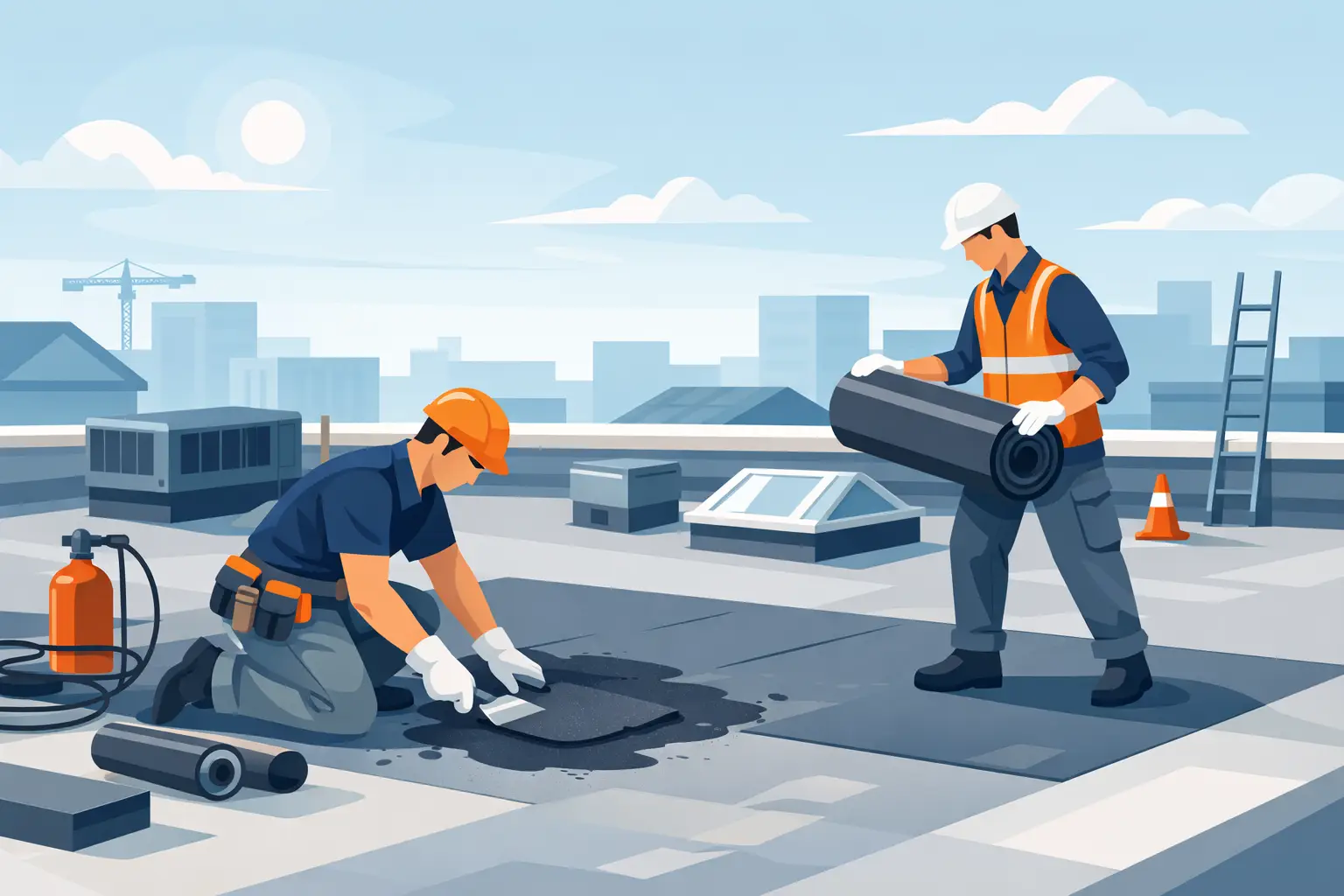
A leak over a retail floor, office suite, or warehouse line rarely starts as a major event. More often, it begins as a small failure around a seam, drain, flashing point, or rooftop penetration, then grows with every storm, freeze-thaw cycle, and day of UV exposure. That is why commercial roof repair services matter so much for building owners and facility teams. The right repair work protects operations, limits interior damage, and helps you avoid turning a manageable issue into a full replacement before its time.
For commercial properties in Nevada and Northern California, roof problems tend to be shaped by harsh sun, wind, heavy rain events, snow loads in some elevations, and sharp temperature swings. Those conditions wear roofing systems differently than in milder regions. A repair approach that works in one climate may not hold up here. What matters is accurate diagnosis, durable workmanship, and a repair plan that fits the roof system, the age of the roof, and the way the building is used.
What commercial roof repair services should actually solve
Good commercial roof repair services do more than patch the visible leak. They should identify how water is entering, how far moisture has traveled, and whether the issue is isolated or part of a wider pattern of failure. On a flat or low-slope roof, water can move laterally before it appears indoors. That means the stain on a ceiling tile is often not directly under the source.
A reliable repair process starts with inspection. That includes reviewing the membrane or surface condition, checking seams and transitions, evaluating drains and slope, and looking at rooftop units, skylights, parapet walls, and edge details. If the roof has been repaired multiple times, those previous fixes also need to be evaluated. Sometimes the problem is a failed flashing detail. Sometimes it is foot-traffic damage. Sometimes the roof is telling you the system has reached a stage where repairs still make sense, but only as part of a larger restoration or maintenance plan.
This is where experience matters. Different systems fail in different ways. Single-ply membranes, metal roofing, modified bitumen, torch down roofs, and coated systems all require different repair methods. A repair that ignores those differences can hold for a month and fail in the next weather cycle.
When repair makes sense and when it does not
Commercial roof repair is often the smartest first move, but not every roof is a good repair candidate. If the damage is localized and the underlying insulation and deck remain in good condition, a targeted repair can extend service life at a fraction of replacement cost. That is especially true when the issue is caught early.
If the roof has widespread saturation, recurring leaks in multiple areas, major seam failure, or long-term neglect, repairs may only buy limited time. In that case, a restoration system or full replacement may offer better long-term value. The lowest upfront price is not always the lowest lifecycle cost. Spending less on repeated emergency repairs can become more expensive than investing in a more durable solution.
That trade-off matters for owners managing budgets across multiple properties. It also matters for facilities that cannot afford repeat disruptions. A school, medical office, distribution building, or retail center may choose a more comprehensive repair strategy simply because operational reliability has value beyond the roofing line item.
Common problems commercial roof repair services address
Most commercial roof issues fall into a few categories, though the cause is not always obvious at first. Ponding water is one of the most common concerns on low-slope roofs. It puts added stress on seams and flashing while increasing the chance of water intrusion. Drain blockages and poor slope can make that problem worse.
Seam separation is another frequent issue, especially on aging membrane systems exposed to heat and movement. Flashing failures around penetrations, curbs, and wall transitions are also common because those areas experience constant expansion, contraction, and water exposure. On metal roofs, fastener movement, panel laps, and flashing details can become leak points over time. Storm damage adds another layer, with wind, debris impact, and uplift placing sudden stress on vulnerable areas.
Not every issue starts from weather. Deferred maintenance, poor installation, unprotected service traffic, and incompatible past repairs often contribute to premature failure. A direct repair plan should account for all of that, not just the symptom that prompted the call.
Why climate-specific repairs matter
Roofing in Nevada and Northern California is not just about waterproofing. It is about managing sun exposure, thermal movement, seasonal moisture, and in many areas, snow and ice. UV radiation can accelerate membrane breakdown and dry out vulnerable components. Rapid temperature shifts can stress seams and flashing. Snow accumulation and ice formation can expose weaknesses that may stay hidden in warmer seasons.
That is why climate-specific repair recommendations matter. In some cases, the right repair includes reinforcing details that historically fail under local weather conditions. In others, it means pairing repair work with coatings, insulation improvements, or drainage corrections that improve performance year-round. Mountain Valley Roofing has built its work around these regional demands, which is a real advantage when a building needs more than a generic patch.
The value of acting early
One of the most expensive mistakes in commercial roofing is waiting for interior damage before taking action. By the time a leak becomes visible inside, water may already have affected insulation, decking, drywall, inventory, equipment, or tenant space. The roofing repair itself may still be manageable, but the collateral damage is where costs rise fast.
Early repairs also preserve options. A roof with limited damage may qualify for restoration or coating work that extends its life significantly. A roof left unchecked may deteriorate past that point. For property owners trying to control capital expenses, timing is a major part of the equation.
That is also why routine inspections matter. They catch small failures before they become emergencies. A building that gets regular roof evaluations usually sees fewer disruptions, fewer surprise repairs, and better long-term performance from the roofing investment.
What to expect from a dependable repair partner
Commercial roof repair services should be practical, not vague. You should expect a clear explanation of the problem, an honest assessment of repair viability, and recommendations based on the roof’s actual condition. If a repair is the right move, the scope should focus on durability, not just speed. If the roof needs more than a repair, you should hear that plainly.
You should also expect a contractor who understands how to work around occupied buildings, tenant schedules, and operational demands. On commercial properties, the repair itself is only part of the job. Minimizing disruption matters too.
A dependable contractor will also think beyond the immediate leak. That may mean identifying weak areas nearby, recommending maintenance intervals, or planning for future restoration before the roof enters a costly failure stage. That approach saves money because it is based on roof life management, not one-off reaction.
Repair, restoration, and maintenance work together
For many commercial buildings, the best outcome is not a single repair visit. It is a broader plan that combines repairs with maintenance and, when appropriate, restoration. A repair stops active problems. Maintenance helps prevent new ones. Restoration can add years of service life when the roof is structurally sound but showing age.
This layered approach is often the most cost-effective path for owners who want to protect the asset without replacing a roof too soon. It also improves budgeting. Planned work is easier to manage than emergency response, especially across a portfolio of buildings.
The right strategy depends on the roof type, age, repair history, and exposure conditions. There is no one-size-fits-all answer. But there is a clear pattern: buildings that are inspected regularly and repaired correctly tend to last longer and perform better.
Choosing commercial roof repair services with long-term value
When comparing commercial roof repair services, look past the immediate price and ask what the repair is designed to accomplish. Is it a temporary stopgap, or is it meant to hold up under the building’s real conditions? Does the contractor understand your roof system? Are they looking at drainage, flashing, penetrations, and surrounding details, or only the most visible symptom?
A good repair protects more than the roof surface. It protects tenants, equipment, scheduling, energy performance, and the long-term value of the property. That is why skilled commercial repair work should be viewed as an operational investment, not just a maintenance expense.
If your building has an active leak, recurring problem areas, or signs of wear that seem to be spreading, the smartest move is to address it before the next storm tests the roof for you. A timely repair backed by solid workmanship can buy years of added service life and a lot fewer surprises when the weather turns.