
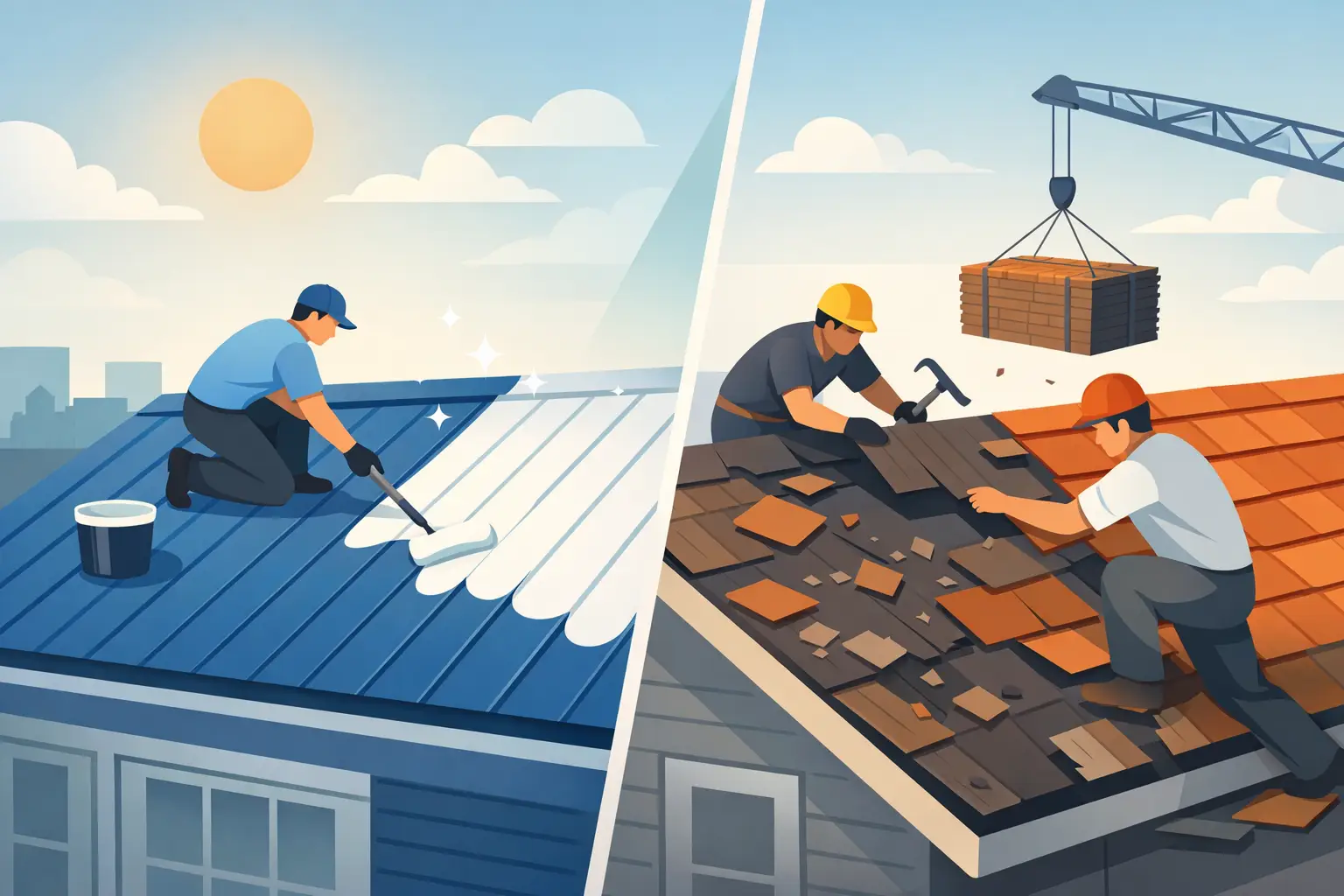
A roof can look worn from the ground and still have years of service left – or it can look decent and already be failing where it counts. That is why roof coating versus replacement is not a question you answer by age alone. The right choice depends on the roof’s condition, the type of system in place, how long you plan to keep the property, and how hard your roof has to work in the climate conditions common across Nevada and Northern California.
For homeowners, the decision usually comes down to budget, leak history, energy performance, and how much risk they are willing to carry into the next storm season. For commercial property owners and facility managers, there is another layer: tenant disruption, lifecycle cost, and whether the roof can be restored without interrupting operations. In both cases, the best answer starts with the same principle – fix what can be preserved, replace what has reached the end of its useful life.
Roof coating versus replacement: what is the real difference?
A roof coating is a restoration solution. It is applied over an existing roof system to create a renewed protective surface that resists UV exposure, weathering, and water intrusion. On the right roof, a coating can extend service life, reduce heat gain, and delay the much larger expense of a tear-off and full replacement.
A roof replacement is a full rebuild of the roofing system or a major portion of it. That usually means removing failed materials, addressing wet insulation or damaged decking, and installing a new system designed for the structure and climate. Replacement costs more upfront, but it gives you the opportunity to correct structural issues, upgrade materials, and reset the roof’s lifespan.
The key point is simple: coatings restore a roof that is still fundamentally sound. Replacement solves a roof that is too deteriorated to restore with confidence.
When a roof coating makes sense
Coatings are often a strong option for low-slope and flat commercial roofs, metal roofs, and certain residential roof applications where the substrate remains in good condition. If the roof has minor weathering, localized repairs, aging seams, or sun-related surface breakdown but the insulation and deck are still dry and stable, restoration can be the more cost-effective move.
This matters in high-sun regions especially. UV exposure wears roofing systems down year after year, and a quality coating can add a reflective layer that reduces surface temperatures and slows further deterioration. For many property owners, that means lower thermal stress and better energy performance without the downtime of a full reroof.
Coatings also make financial sense when the goal is to extend roof life without taking on a major capital project right away. If your building needs a reliable roof now but a replacement is better timed for several years down the road, restoration can bridge that gap. That is often a smart move for facilities managing multiple properties or for owners planning other large improvements.
Still, a coating is not a shortcut. The roof has to be prepared correctly, repairs have to be made first, and the system has to be a fit for the existing roof type. If that prep work is skipped, the coating will not deliver the lifespan or performance you are paying for.
Signs your roof may be a good coating candidate
A good candidate typically has manageable wear, not widespread failure. You may see surface aging, small areas of ponding, minor seam issues, or isolated leaks that can be repaired. The roof may be older, but not saturated, unstable, or separating across large sections.
Commercial roofs often fall into this category when the membrane is still attached well and the substrate below has not been compromised. Metal roofs can also respond well when the main issues are oxidation at the surface, fastener details, and weathered seams rather than severe panel failure.
When replacement is the better investment
There is a point where restoration stops being cost-effective. If the roof has extensive trapped moisture, recurring leaks in multiple areas, deteriorated decking, failing insulation, storm damage that goes beyond the surface, or repeated repairs that never hold for long, replacement is usually the safer and more economical path.
This is especially true when the problems are below the top layer. A coating can protect the surface, but it cannot remove wet insulation, repair rotten wood, or correct structural weakness. In those cases, applying a coating may only delay the inevitable while allowing hidden damage to continue.
Replacement is also the better choice when the existing roof design no longer fits the building’s needs. If drainage is poor, flashing details are outdated, ventilation is inadequate, or the current system simply is not well suited to snow load, temperature swings, or intense sun exposure, replacement gives you a chance to build a better-performing roof from the ground up.
For homeowners, replacement often makes sense when the roof is near the end of its expected service life and repair costs keep stacking up. For commercial buildings, the trigger may be more strategic: avoiding interior damage, preserving tenant operations, and protecting long-term asset value.
Signs replacement should not be postponed
If leaks keep returning after repairs, that is a warning sign. If the roof deck feels soft, if water has entered insulation, if shingles or membranes are failing across large areas, or if storm damage has compromised the system, replacement deserves serious attention.
Age alone is not the deciding factor, but age plus repeated problems usually tells a clear story. A roof that needs constant patching is rarely the low-cost option in the long run.
Cost is important, but lifecycle value matters more
Most property owners first compare coating and replacement based on immediate price. That is understandable. Coatings generally cost less upfront because they avoid much of the tear-off, disposal, and reconstruction involved in a full replacement.
But the smarter comparison is cost over time. If a coating adds meaningful years to a sound roof and improves energy efficiency, it can deliver strong value. If a coating is installed over a roof that is already failing underneath, the lower upfront price can become wasted money followed by a replacement anyway.
The same logic applies in reverse. A replacement may carry a higher initial investment, but if it eliminates recurring leaks, reduces emergency repair bills, improves insulation performance, and gives the building a longer service life, it may be the more economical decision over the full ownership period.
This is where a detailed inspection matters. You are not just buying a product. You are choosing the repair path that best protects the building and controls future costs.
Roof coating versus replacement for commercial properties
Commercial buildings often benefit most from coatings when the roof is serviceable and the goal is restoration without major disruption. Coatings can limit tear-off waste, reduce downtime, and help preserve existing assets. For facility managers balancing budgets across multiple sites, that can be a major advantage.
That said, commercial roofs also hide problems that are not obvious from a quick walk-through. Saturated insulation, failed flashing, membrane separation, and drainage issues may point to replacement even when parts of the roof still look usable. A professional assessment should include not just surface condition, but the roof assembly below it.
For warehouses, retail centers, office buildings, multifamily properties, and industrial sites, the right answer often comes down to risk tolerance. If protecting operations is the top priority, replacement may be worth it when the roof has too many unknowns. If the system is still structurally sound, coating can be an efficient way to extend performance and control costs.
What homeowners should know before deciding
Residential roof decisions are often more emotional because the home is personal, not just an asset on a spreadsheet. Even so, the same practical standards apply. If your roof has isolated wear and a restoration option fits the material and condition, coating may help extend its life. If it has widespread damage, chronic leaks, or major age-related breakdown, replacement is the safer path.
Homeowners should also think about resale, insurance, and weather exposure. A full replacement may offer more confidence if you plan to stay in the home for years or want to avoid surprise problems during a sale. On the other hand, restoration can be a smart move when the roof still has solid structure and you want to improve performance without the expense of full replacement.
The best decision starts with roof condition, not guesswork
The mistake property owners make most often is choosing based on price before understanding the roof’s actual condition. A coating is not automatically the affordable choice, and replacement is not automatically the overspend. Each can be the right answer in the right situation.
An experienced contractor should evaluate leaks, drainage, moisture intrusion, substrate condition, flashing, penetrations, and the remaining life of the system. That inspection should lead to a recommendation based on facts, not pressure. A roof that can be restored should not be replaced early. A roof that has failed should not be coated just to postpone a hard decision.
Mountain Valley Roofing has worked with property owners across demanding climates long enough to know that durable results come from matching the solution to the roof, not forcing the roof into the wrong solution. If you are weighing coating against replacement, the most useful next step is a thorough inspection and a straight answer. A good roof decision should buy you confidence, not just time.