
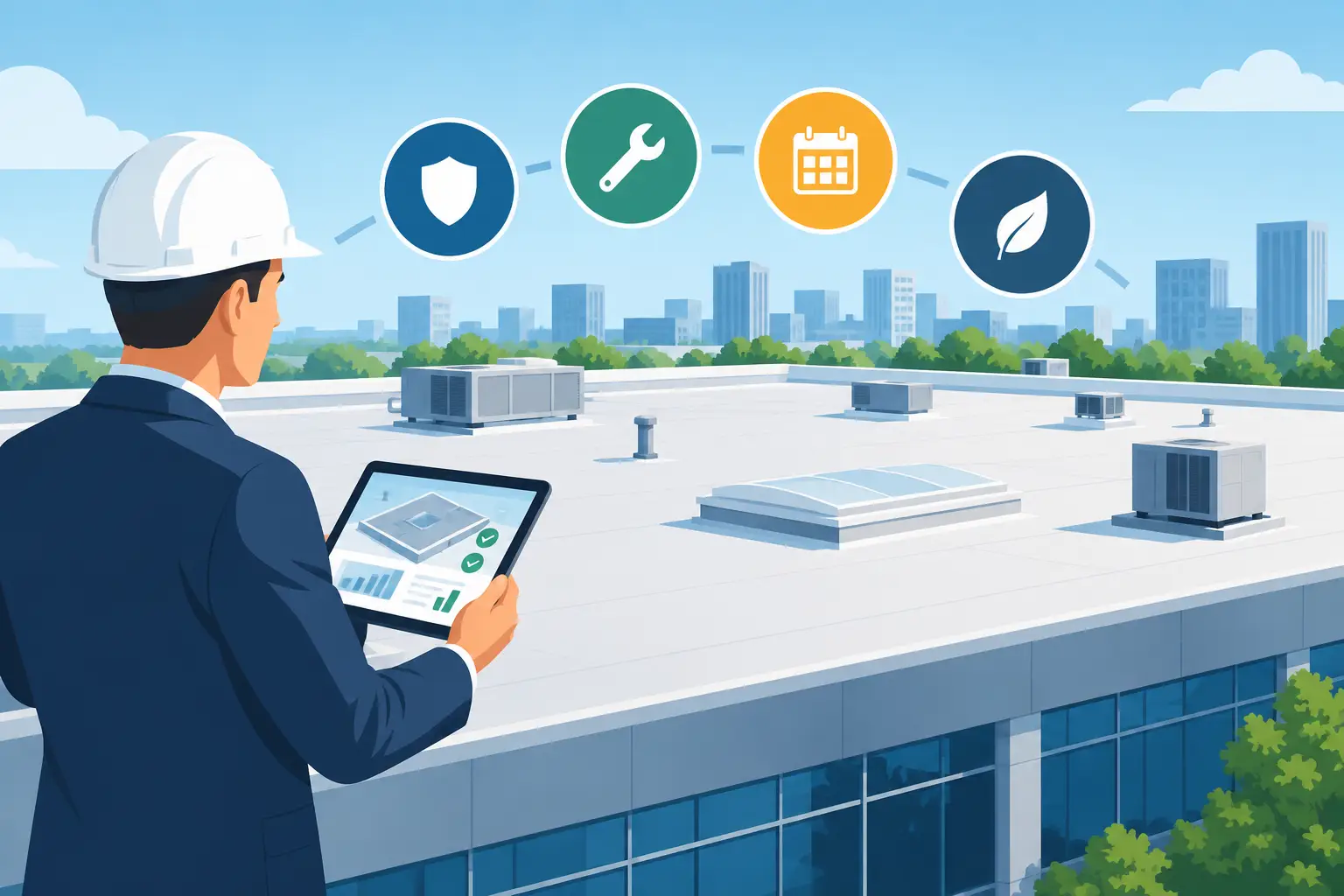
A commercial roof rarely fails without warning. Small membrane splits, clogged drains, loose flashing, and aging sealant can develop for months before water reaches the interior. By the time a ceiling stain appears, the repair may involve insulation, decking, electrical systems, inventory, or tenant operations. This commercial roof asset management guide helps building owners and facility managers treat the roof as a long-term investment instead of an emergency expense.
For properties in Nevada and Northern California, that approach matters. Intense UV exposure, wind, snow loads, freeze-thaw cycles, and sudden storms all place pressure on low-slope roofing systems. A disciplined plan gives decision-makers a clear view of roof condition, remaining service life, current risks, and the most cost-effective time to repair, restore, or replace.
What Commercial Roof Asset Management Means
Roof asset management is the process of documenting, inspecting, maintaining, budgeting for, and making informed decisions about every roof under your responsibility. It goes beyond scheduling a repair when a leak occurs. The goal is to preserve waterproofing performance, extend usable roof life, and avoid avoidable capital costs.
For a single building, the plan may be straightforward. For a portfolio of warehouses, retail centers, office buildings, multifamily properties, or industrial facilities, it becomes a way to prioritize limited maintenance dollars. Not every roof needs replacement at the same time, and not every aging roof is a good candidate for restoration. Accurate information prevents broad assumptions from driving expensive decisions.
A useful roof asset record should identify the roof type, installation date, square footage, warranty status, prior repairs, drainage configuration, rooftop equipment, and known problem areas. It should also include photographs and inspection notes that make condition changes easy to track over time.
Start With a Reliable Roof Baseline
The first step is a professional inspection that establishes what is actually on the building and how it is performing. This should be more than a quick walk-around after a storm. A qualified commercial roofing contractor evaluates the membrane or surface, seams, penetrations, parapet walls, edge metal, flashings, drains, scuppers, expansion joints, and visible signs of trapped moisture or substrate deterioration.
The inspection should answer practical questions: Is the roof currently watertight? Are repairs isolated or recurring? Is drainage working as designed? Has UV exposure weakened the surface? Are rooftop HVAC units creating concentrated wear around curbs and service paths? Is the system still a candidate for coating or restoration?
Roof type affects the answer. Single-ply membranes can develop seam, puncture, or flashing issues. Modified bitumen and torch-down systems may show aging at laps, granule loss, or splits. Metal roofs need attention at fasteners, panel laps, penetrations, and oxidation-prone areas. Each system has different repair methods and different indicators of remaining life.
A baseline inspection also identifies safety and access concerns. If technicians regularly cross the roof to service mechanical equipment, designated walk pads and better coordination can prevent premature damage. If drainage is blocked by debris or poorly placed equipment, the risk is not just standing water. Persistent ponding can accelerate material breakdown and expose weaknesses at seams and flashings.
Build a Roof File That Supports Decisions
Good decisions require records that are easy to find when an issue arises. Create a roof file for each building and update it after every inspection, repair, storm event, and capital project. This does not require a complicated software platform to be useful, although larger portfolios may benefit from one.
The file should include roof plans, inspection reports, photographs, warranty documents, repair invoices, maintenance logs, and a timeline of major work. Record the location and cause of each leak, not just the repair performed. A leak near a drain may point to a drainage issue, while recurring leaks at the same wall flashing may indicate movement or a detail that needs a more permanent correction.
This history helps distinguish one-off maintenance from a pattern. It also gives property managers stronger documentation for ownership groups, budget reviews, insurance discussions, and contractor planning.
Set Inspection and Maintenance Intervals
A commercial roof should be inspected at least twice each year, typically before and after the most demanding weather season. Additional inspections are wise after high-wind events, hail, heavy snowfall, extended standing water, or construction activity that affects the roof.
Maintenance visits should focus on preventing small defects from becoming water intrusion. Common work includes clearing drains and scuppers, removing debris, resealing minor penetrations, repairing damaged flashing, checking edge metal, and addressing punctures before they spread.
The right interval depends on the building. A newer roof with limited foot traffic may need less frequent corrective work than an older roof with multiple HVAC units, trees nearby, or a history of drainage problems. Facilities with critical operations, sensitive equipment, tenant improvements, or high interior replacement costs should take a more conservative approach. The cost of planned maintenance is usually minor compared with operational disruption from an active leak.
Prioritize Repairs by Risk, Not by Appearance
A roof can look weathered and still have years of service left. Conversely, a relatively new roof can have a serious vulnerability at a drain, curb, seam, or flashing detail. Prioritization should be based on the likelihood of failure and the consequence if it occurs.
Urgent issues are those already allowing water into the building, threatening electrical or mechanical equipment, creating slip hazards, or compromising structural components. Near-term issues may include open seams, deteriorated sealant, damaged edge metal, or recurring ponding that has not yet caused interior damage. Lower-priority items may be cosmetic surface wear or minor defects that can be monitored during scheduled maintenance.
This ranking is especially valuable when annual budgets are tight. It allows owners to address the work that protects the building first while planning broader restoration or replacement at the right time.
Know When Restoration Makes Financial Sense
Replacement is not always the best first move. If the roof system is fundamentally sound, dry, and still structurally stable, a commercial coating or restoration system may extend its life at a lower cost than a full tear-off. Reflective cool roof coatings can also reduce surface temperatures and help improve energy performance during hot Nevada summers.
Restoration has limits. It is not a solution for widespread moisture saturation, failing insulation, major deck damage, or a roof that has reached the end of its serviceable condition. Applying a coating over unresolved defects can conceal problems temporarily while allowing damage to continue below the surface.
A professional assessment should compare the cost of targeted repairs, restoration, and replacement against expected service life. The least expensive proposal is not automatically the lowest lifecycle cost. A repair program that repeatedly addresses the same failing system can eventually cost more than planned restoration or replacement.
Use a Multi-Year Capital Plan
Roof asset management works best when annual maintenance and long-term capital planning are connected. Once each roof has a condition rating and estimated remaining service life, build a three- to five-year forecast. Include routine inspection costs, expected repair allowances, potential restoration timing, and likely replacement windows.
For portfolios, avoid scheduling every roof project at once unless conditions demand it. Staggering work can smooth capital spending and reduce disruption. At the same time, do not postpone a roof that is nearing failure simply to meet a budget cycle. Water intrusion can turn a planned project into a far more expensive emergency.
Account for changes to the property as well. New HVAC equipment, solar installations, tenant improvements, or added rooftop access can affect roof details, drainage, and warranty requirements. Roofing should be part of the project conversation before equipment is installed, not after penetrations have created a problem.
Choose Contractors Who Document the Work
Commercial roof maintenance depends on workmanship and accountability. Select a contractor that understands the specific roof system, documents conditions clearly, and provides repair recommendations tied to observed risks. You should receive photos, a description of work completed, and a practical explanation of what should be monitored next.
For Mountain Valley Roofing, commercial service means looking beyond the immediate leak. A repair should protect the detail that failed while considering drainage, membrane condition, surrounding penetrations, and the building’s long-term budget. That is how routine roof care becomes a measurable asset-protection strategy.
A well-managed roof does not demand attention every day. It earns its value quietly by keeping water out, supporting efficient building operations, and giving owners time to make planned decisions. Start with an accurate inspection, keep the records current, and address small problems while they are still small.