
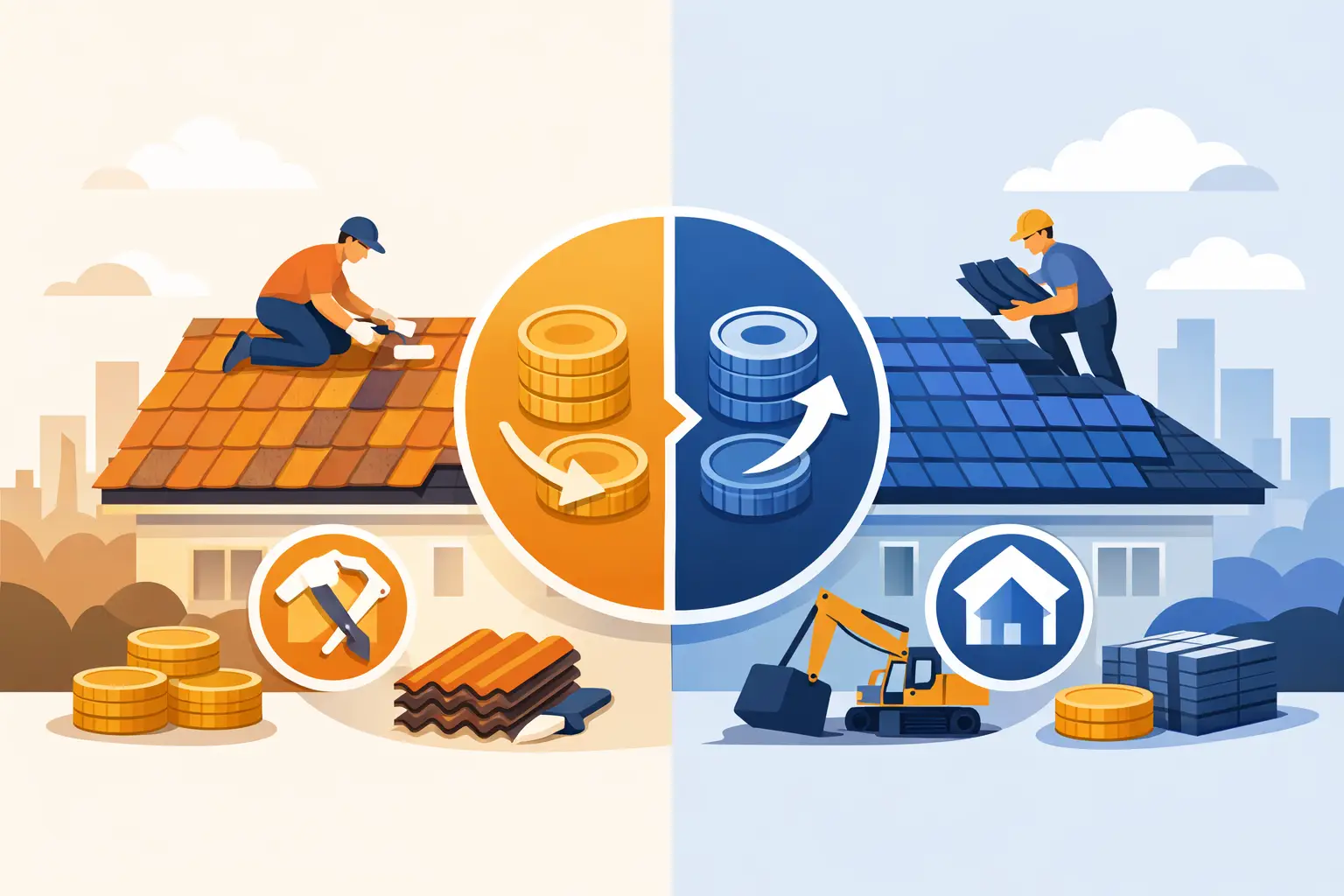
A roof that leaks after a Sierra snowstorm or begins blistering under Nevada sun puts property owners in a difficult position: spend enough to solve the problem correctly, without paying for work the roof does not yet need. The roof restoration vs replacement cost decision is not simply about choosing the lower estimate. It is about the roof’s remaining condition, the building’s needs, and the expected value of the work over time.
For many commercial low-slope roofs and some residential systems, restoration can extend useful service life at a substantially lower upfront cost than a full tear-off. But coatings and restoration systems are not a shortcut for a roof with widespread saturated insulation, failing structure, or damage that has already reached the end of its serviceable life. A thorough inspection is what separates a cost-effective restoration from money spent postponing an inevitable replacement.
Roof Restoration vs Replacement Cost: The Basic Difference
Roof restoration is a process designed to renew an existing roof system rather than remove it. Depending on the roof type and condition, the work may include repairs to seams and penetrations, replacement of damaged sections, cleaning, preparation, and application of a protective coating or restoration membrane. The goal is to restore waterproofing, improve UV resistance, and add years of service without the expense and disruption of a complete tear-off.
Roof replacement involves removing the existing roofing materials, addressing any damaged decking or insulation, and installing a new roofing system. It is a larger investment because it includes more labor, material, disposal, and often more extensive repairs below the roof surface. In return, it provides a reset for a roof system that has suffered broad deterioration.
Restoration generally has a lower upfront cost because the existing roof remains in place. Replacement costs more initially, but it can be the better financial choice when repairs would only treat visible symptoms while deeper problems continue underneath.
What Determines the Cost of Each Option?
No responsible contractor can price a roof accurately from square footage alone. Two buildings with the same roof area can require very different scopes of work. A clean, well-maintained single-ply commercial roof with minor seam issues may be an excellent restoration candidate. Another roof of the same size may have wet insulation, trapped moisture, damaged flashing, and multiple old repairs that make replacement the more reliable path.
For restoration, cost is driven by the existing roof material, surface preparation, repairs required before coating, roof access, drainage conditions, the type of coating or membrane selected, and the desired warranty term. A roof with extensive ponding water or deteriorated penetrations needs corrective work before a restoration system can perform as intended.
Replacement costs depend on tear-off requirements, the number of existing roof layers, disposal, deck repairs, insulation upgrades, slope and access, skylights or rooftop equipment, and the selected system. Shingle, metal, torch down, and single-ply membrane roofs each have different material and installation requirements. A building occupied during construction may also require added planning to protect operations and minimize disruption.
Weather matters in Nevada and Northern California. Intense UV exposure, wind, snow loads, temperature swings, and ice-related conditions can shorten the life of a roof that was not designed or maintained for the environment. The least expensive system on day one is not always the most cost-effective system over its service life.
When Roof Restoration Delivers the Best Value
Restoration is usually worth serious consideration when the roof is structurally sound, leaks are limited and repairable, and the insulation beneath the membrane remains dry. It is especially useful for commercial properties with low-slope roofs that need renewed waterproofing and better solar reflectivity without the downtime of a major tear-off.
A properly specified coating system can reflect heat, reduce roof-surface temperatures, and help lower cooling demand. That can be particularly valuable for warehouses, retail buildings, multifamily properties, and facilities with large exposed roof areas. The energy benefit varies by building design, insulation, HVAC operation, and coating color, but a reflective roof can support more consistent performance during hot summer months.
Restoration also reduces landfill waste because the existing roof is not removed. For property owners managing several buildings, that lower disruption and controlled capital expense can make it possible to address roofs proactively instead of waiting for a failure.
Still, restoration must start with preparation. Coating over open seams, wet materials, poor drainage, or an uncorrected leak is not restoration. It is a temporary cover that may fail early. The right contractor will identify repair needs, test for moisture where appropriate, and explain what the roof can realistically support.
Signs a Roof May Be a Restoration Candidate
A roof may be suitable for restoration if it has a stable substrate, isolated rather than widespread leaks, limited surface wear, and no evidence of extensive trapped moisture. Aging coatings, minor cracking, seam deterioration, and UV-related surface breakdown can often be addressed before they become full-system failures.
For residential roofs, restoration is more selective. Some metal roofs and certain low-slope systems may benefit from restoration work. Standard asphalt shingle roofs with widespread granule loss, curling, brittle shingles, or multiple active leaks more often require replacement to provide dependable long-term protection.
When Replacement Is the Smarter Investment
Replacement becomes the practical choice when a roof has reached the point where restoration cannot create a reliable system. If moisture has saturated insulation across large areas, the decking is compromised, leaks are recurring in multiple locations, or the roof has too many aging layers, a new roof may prevent years of escalating repair costs.
A full replacement also creates an opportunity to correct issues that restoration cannot solve. This may include improving insulation, upgrading drainage, replacing deteriorated flashing, adding snow retention measures, installing heat tape in vulnerable areas, or choosing a cool roof system suited to the building’s exposure. Those improvements can protect the entire building envelope, not just the roof surface.
For homeowners, replacement may make more sense when the roof is near the end of its expected lifespan or when storm damage has affected a broad area. For commercial owners and facility managers, replacement may be preferable when roof failures threaten inventory, tenant operations, equipment, or business continuity. The cost of water damage and operational disruption can exceed the price difference between a restoration and a new system.
Compare Lifecycle Cost, Not Just the Estimate
The lowest proposal does not always produce the lowest ownership cost. A better comparison considers what each option is expected to deliver over its service life. Ask how long the restoration or replacement is designed to perform, what repairs are included, which conditions are excluded, how drainage is being addressed, and what maintenance will be needed to protect the investment.
A restoration that extends a viable roof for many years can preserve capital for other building priorities. A replacement that eliminates persistent leaks and improves insulation may provide stronger long-term value than repeated repairs and short-term coating applications. The answer depends on condition, not preference.
It is also wise to consider risk. A property with sensitive equipment, finished interiors, high-value inventory, or occupied tenant spaces has less tolerance for a roofing system that is likely to need frequent intervention. In those cases, reliability may carry more value than the initial savings of a limited repair approach.
Start With a Detailed Roof Assessment
The most useful next step is a professional roof inspection that documents current conditions instead of assuming them. A qualified assessment should examine the roof surface, seams, flashing, penetrations, drainage, insulation condition when accessible, and any signs of moisture intrusion or structural deterioration. Photographs and a clear scope of recommended work give owners a sound basis for comparing options.
Mountain Valley Roofing helps property owners evaluate restoration, repair, and replacement options based on climate exposure, roof condition, and long-term performance goals. The recommendation should fit the building, not force every roof into the same solution.
A roof that can be restored should be restored correctly and maintained carefully. A roof that has reached the end of its service life deserves a replacement system built to handle the years ahead.